What the Midterms Mean for the Market
A landslide, but what will its impact on the market be?
In politics, a "wave," is an election cycle where one political party wins a large-scale, sweeping majority of seats in a legislature, like the house or senate. You can get a general idea of what a "tsunami," in politics denotes. The Democrats have achieved just that with as of writing of this post, achieved large majorities in both the house and senate, breaching Republican strongholds like Kansas and Texas.
Winners and Losers
As with almost all events, there are clear winners and losers. Starting off with the S&P 500, it upholds a flawless historical record of being higher 12 months after midterms. This is because, either way, it benefits: if there is no absolute control by one party, it is less likely that the legislative branch will be able to repeal—say, tax breaks—because of gridlocked politics. And if one party establishes clear and absolute control, like this midterm, then there is less uncertainty in politics, leading to higher returns as well. The market does usually prefer gridlocked politics. In divided-government outcomes, the S&P 500 averaged a 15% one-year gain, compared to 11.5% under single-party control since 1980.
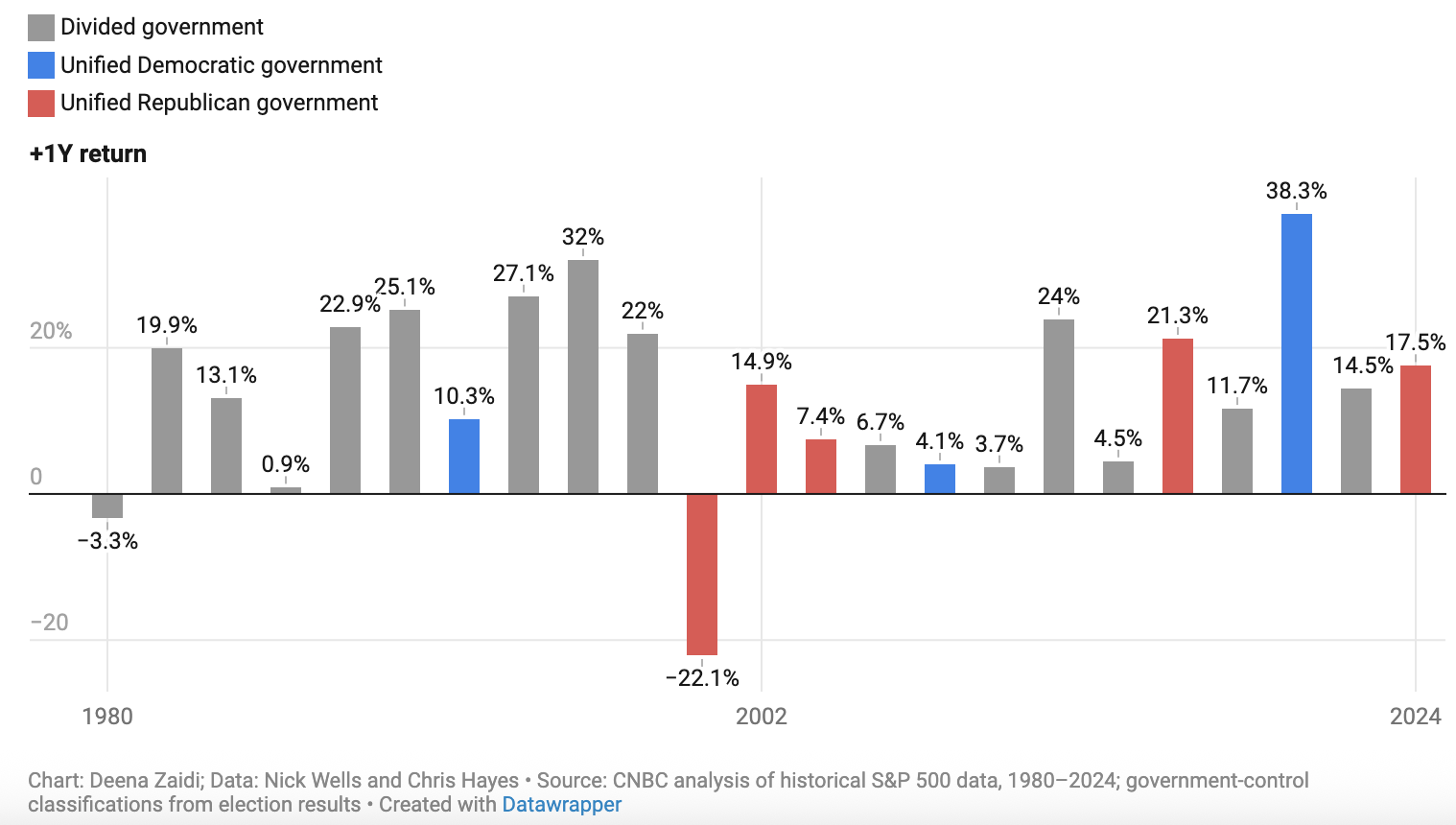
But, the S&P isn't the entire market, so how does the rest of the market preform? Certain industries are more exposed than others. Defense, energy, and in recent years more with the rise of AI, tech are all heavily affected by politics. Defense could easily - and probably will - be affected by midterms. Most likely there will be a loss as budget trimming is on the table and increased oversight on contracts and how money is spent will most likely be implemented. This would directly affect the defense companies, as the pool of contracts dries up. Energy is more of a mixed picture. The Democrats look to relive pressure off of renewables, but will likely shun fossil fuels. Those two are historically affected by politics. A newer one is tech. This is mainly because of the prolific rise of AI, becoming a vital political issue. Why is that? This is mainly because, first, local and state politics have been dominated by issues like data centers and their environmental footprint, the race between the U.S. and China for AI dominance, and the broader societal impacts of artificial intelligence itself. Expect increased regulatory scrutiny on a state standpoint as politicians try to outdo each other in preventing the hated (at least by voters) data-centers from being built. Safety reporting and monitoring will also likely included in the new regulatory climate. This presents a loss to many tech companies.
Shorter versions of these arguments, with louder charts, live on Instagram.
@mr.milkmoney