Whiplash: The AI Market's Correction, Collapse, and Comeback
Nasdaq flirted with a 10% correction, Situational Awareness imploded, and stocks snapped right back — volatility isn't a glitch in this market, it's the operating system
The correction
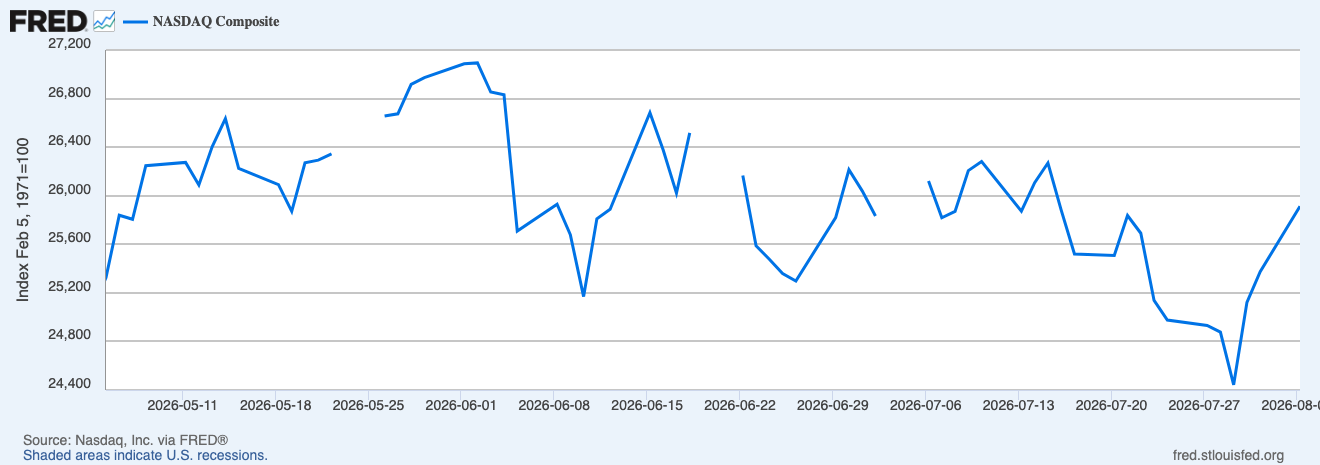
The Nasdaq 100 came within a hair of a full correction, falling as much as 9.3% from its June 2 record high. What made it notable wasn't just the size of the drop but the speed: hitting that threshold would have taken just 38 trading days, versus more than 100 sessions for the prior correction back in March.
The trigger was Alphabet's earnings. The company posted its first-ever negative free cash flow as a public company, driven by heavy AI-related capital spending — and it crystallized a question the whole market had been avoiding: is all this AI infrastructure spend actually going to pay off? With global enterprise AI infrastructure spending on pace to hit roughly $870 billion by year-end, a 77% jump from last year, the stakes for a "yes" answer are enormous. Semiconductors took the brunt of the selloff, with the sector benchmark falling into bear-market territory.
The collapse
Then came the more dramatic story: Leopold Aschenbrenner's hedge fund, Situational Awareness, went from AI-investing folk hero to cautionary tale in about two weeks. The fund — built on Aschenbrenner's widely-read 2024 AI manifesto and reportedly running leverage as high as 400% — collapsed from $45 billion to around $10 billion in assets amid falling semiconductor stocks and mounting margin calls. Prime brokers eventually forced a distressed sale of its leveraged public holdings, including SK Hynix and CoreWeave, to Citadel at below-market prices.
It's a useful case study: Aschenbrenner's fund wasn't just another AI bull — it was arguably the highest-conviction, most publicly documented AI thesis on Wall Street. Its unwind is a reminder that leverage, not just a wrong thesis, is usually what turns a rough patch into a blowup.
The comeback
If the correction felt dramatic, the recovery has been just as sharp. Since the July 29 low, the Nasdaq has surged almost 9%, and by August 4 it was only about 2% away from its record high. The S&P 500 has already retaken its own record, and the Dow closed above 54,000 for the first time ever.
That round-trip isn't an anomaly — it's the pattern. Stocks have historically fully recovered from every correction and bear market, and one research firm's analysis found the Nasdaq-100 could recoup its correction losses in as little as two months if the late-July low turns out to have been the bottom.
Volatility itself is somewhat structural here, not just a one-off event. August is historically the second-worst month for the S&P 500, with the third-highest average volatility of any calendar month. And the underlying cause hasn't gone anywhere: this was already the Nasdaq's second correction of 2026. As long as the index is driven by growth stocks priced on future potential rather than current earnings, more of these swings should be expected.
Shorter versions of these arguments, with louder charts, live on Instagram.
@mr.milkmoney