The Warsh Paradox: Trump's Pick for Lower Rates Keeps Delivering the Opposite
He was nominated to cut. Five months in, he's held rates steady four times, dropped forward guidance entirely, and had FOMC members penciling in a 2026 hike. Here's how to read what he actually does next.
The setup: why Warsh was supposed to be the dovish pick
When Trump nominated Kevin Warsh to succeed Jerome Powell in May 2026, the framing was straightforward: this was the rate-cut chair. Trump had spent years attacking Powell for keeping rates too high, and Warsh was reportedly chosen in part for his willingness to cut and his skill at persuading a committee, not just following one—a skill needed to chair the Federal Open Market Committee (FOMC). Wall Street largely read it the same way—Barclays and Morgan Stanley both kept their base case for additional rate cuts in place right after the nomination, even as Barclays' Marc Giannoni flagged how much resistance further cuts were likely to meet.
That's not what's happened.
What's actually happened since he took over
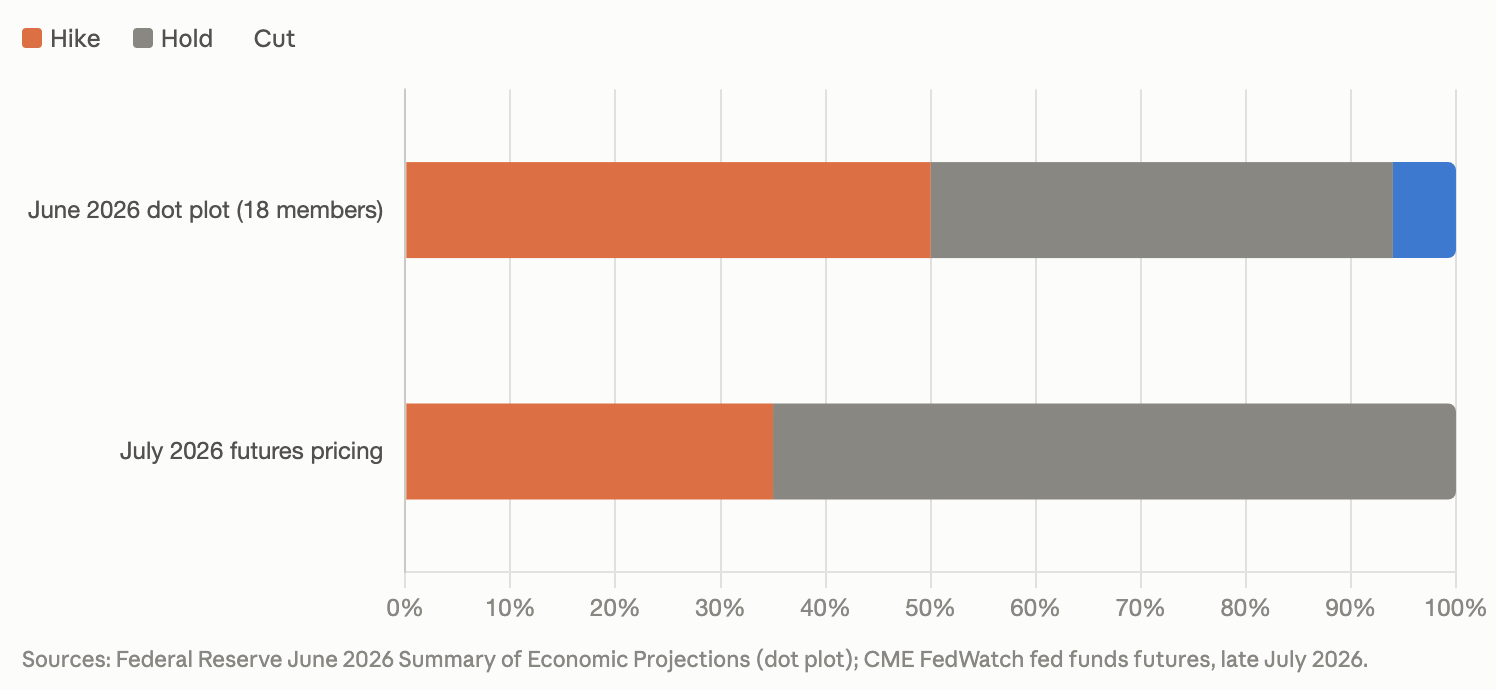
Warsh's first meeting as chair, in June 2026, delivered what multiple outlets called a "hawkish shock." The Fed held rates steady at 3.50%-3.75% for a fourth consecutive time, but the real surprise was in the details: the committee stripped its statement of language about "additional rate adjustments," and nine of eighteen FOMC participants penciled in at least one rate hike for 2026 — a dramatic reversal from projections that had leaned toward cuts just months earlier. Markets sold off hard on the news. In his press conference, Warsh was blunt: "We've missed on inflation for five years and we're going to fix that."
He's held that line since. At the July meeting — held rates again, the fifth straight hold — three officials dissented, and Warsh gave famously terse answers to reporters ("I've got nothing more to say than the statement itself"). Two-year Treasury yields jumped to their highest level in over a year on the news.
The bigger structural move: killing forward guidance
The more consequential change isn't any single rate decision — it's how Warsh has restructured the way the Fed communicates entirely. He's launched five internal task forces to review how the Fed makes decisions and talks to markets, deliberately moving away from the kind of explicit forward guidance that defined the Powell and Bernanke eras. Morgan Stanley warned ahead of his first meeting that Warsh would reshape Fed communications, and that is roughly what happened. The stated logic: the Fed had become too backward-looking and too locked into telegraphing its next move, which limited its flexibility when conditions changed quickly.
The practical effect has been a genuinely more opaque, harder-to-predict Fed. Ahead of the July meeting, fed funds futures markets showed an unusually wide 35%-65% split on whether the Fed would hold or hike — far more uncertainty than markets are typically left to sit with. That's arguably by design, but it also means every meeting now carries more volatility risk than the market got used to under Powell.
So is he actually hawkish, or is this strategic?
This is where it gets genuinely interesting, and where a purely "hawkish chair" reading probably oversimplifies things. A few threads worth holding onto at once to help understand:
- Warsh has directly said one-time price shocks — from energy, or from AI-driven demand — aren't automatically inflationary in the way sustained wage-price spirals are. That's a more nuanced position than pure inflation-hawk orthodoxy.
- [NEEDS SOURCE — flagged for review] Analysts covering his Senate hearings back in April described his tone there as "broadly dovish, pragmatic, and respectful of institutional independence" — a notably different read than the market's reaction to his first two meetings as chair. This exact characterization isn't backed by a confirmed source yet; verify or cut before it stays in.
- One plausible read from CNBC analysis ahead of the July meeting: Warsh personally may not even buy the case for a hike, but is playing for time — voting to hold protects the credibility of his task-force review process, and holding fire now preserves his ability to act more decisively once those reviews conclude later in 2026.
- He's also managing real political crosscurrents: Trump wants cuts, Powell remains on the board as a sitting FOMC member, and Warsh needs the committee's buy-in for any structural changes to Fed communication or the balance sheet — meaning some of the "hawkish" caution may be about building consensus, not personal conviction.
Shorter versions of these arguments, with louder charts, live on Instagram.
@mr.milkmoney