No Landing: Why "Temporary" Might Be the Only Thing Everyone Agrees On
Consumers and businesses now expect inflation to stay elevated — here's what that means, and why a "no landing" can't be the final destination
The landing metaphors, explained
Three terms have dominated macro commentary for years now, and they're worth defining clearly before going further:
- Soft landing: The Fed slows inflation back toward its 2% target without tipping the economy into recession — growth cools just enough to relieve price pressure while the labor market stays intact.
- Hard landing: The Fed succeeds in crushing inflation, but only by triggering a recession — a sharp drop in economic activity and a meaningful rise in unemployment.
- No landing: The economy simply doesn't slow down. Growth and the labor market stay firm, but inflation refuses to fall back to target despite restrictive policy — meaning the central bank has to stay tighter for longer, or worse, tighten further.
The "no landing" label matters because it implies something the other two don't: this isn't a resolution, it's a holding pattern. Growth and inflation staying elevated simultaneously isn't a steady-state outcome — eventually something gives.
What the data is actually showing right now
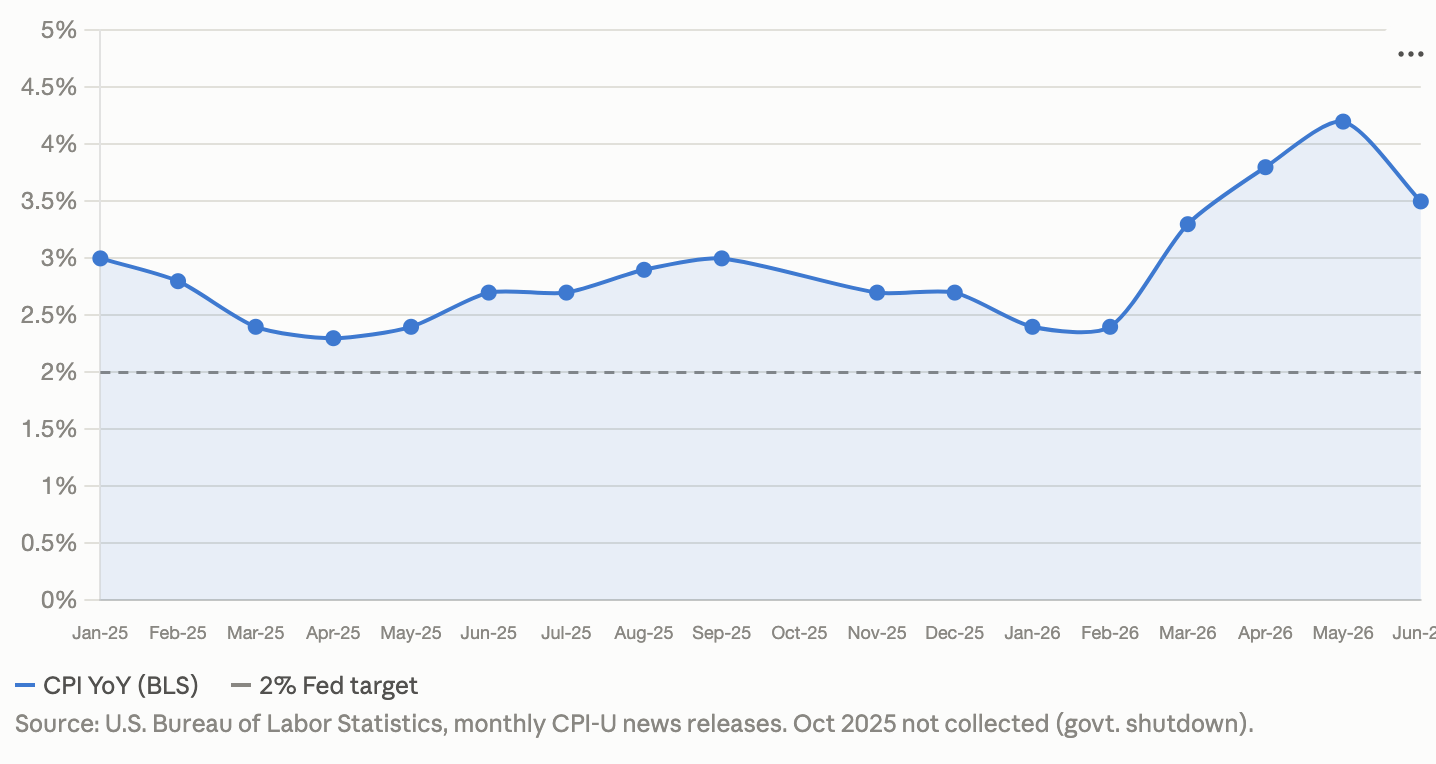 Image without a description
The current numbers put the U.S. squarely in "no landing" territory — though the details matter. Headline CPI came in at 3.5% year-over-year in June 2026, down from 4.2% in May as the earlier oil-price shock from the Middle East conflict faded. Core CPI (excluding food and energy) was 2.6% year-over-year, and was flat — 0% — month-over-month, the first flat monthly core reading in years. Both are cooling from the spring's spike, but headline inflation is still 75% above the Fed's 2% target, and core hasn't been at target since before the pandemic. Growth hasn't slowed either — labor market data has stayed resilient through the year.
Meanwhile, the forward-looking expectations data — arguably more important than the trailing inflation print itself — is sending an unambiguous signal: people don't believe this is temporary.
- Consumer one-year-ahead inflation expectations rose to 3.7% in June 2026, the highest reading since September 2023, according to the New York Fed's Survey of Consumer Expectations. Three-year-ahead expectations climbed to 3.3%, the highest since June 2022.
- What makes this notable is the disconnect: gas and food price expectations actually fell over the same period, but overall inflation expectations rose anyway — a sign that consumers have simply stopped extrapolating from any single falling price and are instead pricing in inflation as a persistent condition.
- On the business side, the NFIB's June 2026 survey found 38% of small business owners raising prices, the highest share since early 2023, and inflation was named the single most important business problem by 21% of owners — the highest share since October 2024. Even as broader small-business optimism improved, pricing pressure got worse, not better.
That combination — cooling headline inflation data, alongside rising expectations from the people actually setting prices and making purchasing decisions — is exactly the pattern that keeps a central bank in a bind. Expectations are partly self-fulfilling: if businesses expect to keep raising prices and workers expect to keep needing raises, that behavior itself sustains inflation independent of what the "hard" data says.
Why the Fed looks like it's playing "no landing" right now
The current policy stance fits the no-landing description closely. The Fed has held its policy rate at 3.50%–3.75% since mid-2026, well above where it would sit if inflation were convincingly returning to target, and new Fed Chair Kevin Warsh has taken a notably hawkish posture — moving away from traditional forward guidance in favor of a purely data-dependent approach. That's a central bank choosing to stay restrictive rather than risk declaring victory early, which is precisely the posture a no-landing environment forces: growth hasn't given the Fed a reason to ease, and inflation hasn't given it the confidence to stop worrying.
Why no landing can't last forever
"No landing" isn't a fourth, stable outcome sitting alongside soft and hard landings — it's a description of an economy that hasn't decided which of those two it's actually going to become. By definition, it requires two things to hold at once that historically don't coexist indefinitely: above-trend growth and above-target inflation, with policy stuck in between them.
Something eventually breaks that tension. Either growth cracks under the weight of sustained high rates, edging toward a hard landing — or inflation genuinely breaks lower and the Fed can finally ease without reigniting price pressure, a soft landing arriving late. A "no landing" period is delayed resolution, not an escape from the trade-off. And the longer expectations stay elevated the way they are right now, the more the Fed has to lean toward staying restrictive, which raises the odds the eventual landing is the harder one rather than the softer one.
Shorter versions of these arguments, with louder charts, live on Instagram.
@mr.milkmoney